
 Recently, a national discussion has been developing online and in the media regarding sexual violence within sports organizations, most notably Hockey Canada.
As a Sexual Assault Support Centre, we stand with all survivors of sexual violence, including those who have experienced harm by athletes. We know serious problems exist at the root of sports culture that too often result in sexual violence. These problems include:
These problems culminate in what is termed rape culture. It is a fact that the harm caused by rape culture in sports organizations and our broader communities predominately impacts women, girls, and gender-diverse people. And because sexism, racism, and colonialism intersect, Black, Indigenous, and racialized women and girls are at even greater risk of being harmed. Sports organizations and athletes must address the issue of sexual violence in sports to build safer communities for all. Knowing this, working with athletes has been a focus of our Male Allies Program since 2008. Our Leading by Example training supports athletes in becoming community champions in areas such as healthy masculinity and consent. In 2016, we co-created a curriculum for the Ontario Hockey League (OHL) called OHL Onside, and we have been involved in training OHL players since that time. Due to our experience educating for social change within sports organizations, Hockey Canada recently contacted our Public Education team. They requested specialized training for athletes, team staff and Hockey Canada staff in Calgary over the course of the summer. (Read more in their Action Plan.) To support the delivery of Leading by Example workshops, SASC reached out in partnership to Calgary Communities Against Sexual Abuse (CCASA), the primary sexual harassment, sexual abuse and sexual assault crisis, counselling and education service provider for Calgary and the surrounding areas. Together our two organizations are in the process of delivering training to different cohorts, covering topics such as healthy masculinity, consent, the continuum of harm, and bystander intervention through interactive activities and discussions. We believe anti-sexual violence training is a powerful tool for creating social change. That said, for meaningful change to take hold, training needs to be reinforced by an ongoing, fulsome strategy within sports organizations to address sexual violence to shift rape culture within sports. As part of these efforts, governments, sports organizations, and corporations need to recognize the expertise of community-based sexual assault centres across Canada and fund them to provide training to local athletic organizations. If you are a representative from one of these groups, and want to be part of funding this work, please reach out to our Centre We know that men and boys, with their unique ability and responsibility, have an essential role to play as allies in the work to end sexual violence. We encourage our community to connect with us to learn how our Male Allies Program can support your group or organization. Finally, if you are a survivor of sexual violence in Waterloo Region, we are reaching out to you. You are not alone. Our 24-Hour Support Line is available anytime, night, or day at 519-741-8633. To learn more about our services, visit sascwr.org. For Ontarians seeking support outside of Waterloo Region, visit sexualassaultsupport.ca
Kitchener, Ont. – In partnership with the Sexual Assault Support Centre of Waterloo Region (SASC), Women’s Crisis Services of Waterloo Region (WCSWR) is proud to announce two beds, one at each shelter, will be reserved for those experiencing sexual exploitation and trafficking
Funded by SASC, these beds will provide temporary emergency shelter to clients until they are able to access long-term housing support. Lack of access to a safe, emergency shelter is a major barrier for individuals exiting an exploitative situation, as many do not have a safe alternative. “Our Centre is thrilled to launch this partnership with Women’s Crisis Services of Waterloo Region,” says Sara Casselman, Executive Director, Sexual Assault Support Centre of Waterloo Region. “We know access to safe and secure housing is a key component to ending the exploitation of women, girls, trans and non-binary folks who have been trafficked.” Using a trauma-informed, harm reduction, and intersectional feminist approach, SASC’s Anti-Human Trafficking Program provides wrap-around services to those experiencing sexual exploitation and those who are at risk within Waterloo Region. Services are free, confidential and non-judgmental. Those who enter WCSWR’s shelter through this partnership will be enrolled in SASC’s Anti-Human Trafficking Program. WCSWR operates two emergency shelters, Anselma House in Kitchener and Haven House in Cambridge. WCSWR empowers women and children to move beyond violence through the provision of safe shelter, educational resources and outreach services. Offering programs such as addictions support, music therapy and food and nutrition, WSCWR supports and cares for women at each step of their journey. The organization serves women and children 16+ from all cities and townships in Waterloo Region. “This partnership will provide a needed service,” says Jennifer Hutton, CEO, Women’s Crisis Services of Waterloo Region. “It will provide safety for those experiencing exploitation and will provide a community approach to gender-based violence.” This partnership will particularly support those most likely to be targeted by traffickers: young women and girls, members of the 2SLGBTQIA+ community, and Black, Indigenous and Racialized people. It is essential to wrap those most vulnerable to trafficking in community care. If you or someone you know is in need of this service, please contact the Anti-Human Trafficking Program at 519-571-0121 ext. 111 or email [email protected] from Monday-Friday, 9 a.m. to 4:30 p.m. Those needing service after hours can contact Victim Services of Waterloo Region at 519-570-5143. Media Inquiries: Carly Holmstead Communications and Fund Development Supervisor Women's Crisis Services of Waterloo Region [email protected] | 519-742-5894 ex. 2027 Human Trafficking Fact Sheet In Canada, the vast majority (96%) of victims of police-reported cases of human trafficking in 2019-2020 were women and girls. – Statistics Canada, 2022 Of these:
Local Facts:
Last night Region of Waterloo Council unanimously endorsed a resolution calling on the Province of Ontario to provide increased and sustainable funding for community-based Sexual Assault Centres. Watch Sara Casselman's presentation to Council at the 45-minute mark.
 While some people in our Region welcome Jordan Peterson to the publicly funded Centre in the Square, we stand in solidarity/echo others in saying that hate is not welcome here.
Jordan Peterson openly espouses sexist, racist, and transphobic ideology. He encourages violence against women, stating women have “an unconscious wish for brutal male domination.” We believe these viewpoints should not be given a publicly funded platform in our community. Peterson’s perspectives also negatively impact men. As Liz Plank states in her book, For the Love of Men, “instead of persuading men to have compassion for themselves and others, he is instructing them to lean into rugged individualism, fear, and rigidity. Instead of embracing vulnerability, he instructs men to run away from it.” In short, Peterson advocates for adherence to extremely rigid definitions of gender and masculinity - he wants men to stay in the ‘Man Box.’ Research shows that men that are the most likely to perpetrate sexual violence are those who have the most rigid notions of gender. Through our Male Allies Program, SASC is actively working against the harm caused by such viewpoints, and we invite everyone in the community to challenge his toxic perspectives. Here are some suggestions of what you can do to support the community: 1. Support organizations that are who are working in our community to dismantle the toxic ideas that Peterson perpetuates such as Spectrum, SWAN, SHORE Centre, Women’s Crisis Services of Waterloo Region, Healing of the Seven Generations, Coalition of Muslim Women of KW, Land Back Camp, Black Lives Matter Waterloo Region, and of course, SASC! 2. Encourage men in your life to be part of the conversation in counteracting his viewpoints, which could include participating in our Male Allies workshops. 3. Voice your concern to elected officials about publicly-funded venues hosting problematic speakers. 4. Use your platforms to share this message. Stand with us in solidarity against hate. 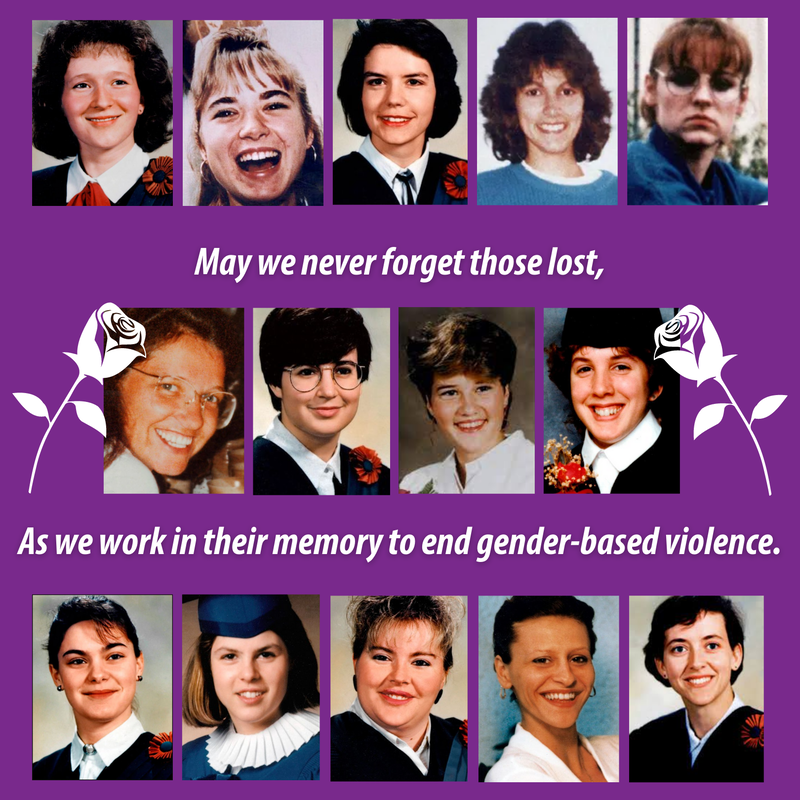 On December 6th, 1989, 14 women were murdered in an anti-woman, anti-feminist attack.
Every year on this day we acknowledge the National Day of Remembrance and Action on Violence Against Women in their memory. 31 years later gender-based violence continues to take lives. This is not an old problem. In fact, it is getting worse. Femicide increased 84% in the first half of 2021. There are over 5000 missing and murdered Indigenous women, girls, and two-spirit people across Canada. November saw the highest number of new intakes to our centre in the history of SASC with 54 people reaching out for the first time. Our centre is on the frontlines of preventing and responding to gender-based violence, but we need your help. Women and girls will continue to experience harm and even death if we do not all work together to address the underlying causes of this violence. We need to dismantle the systems of patriarchy, rape culture, racism, and colonialism. We need proper feminist-based sex and relationships education in schools. We need to create spaces for boys and men to unpack and break down toxic masculinity. We need to stop blaming victims and create more resources for supports. We need everyone to be part of the solution. Follow our Male Allies Program on Facebook, Twitter, and Instagram (@maleallies) to find ways that you can make a difference during the #16Days of Activism Against Gender-Based Violence. If you are struggling we are here to listen. Call our 24 Hour Support Line at 519.741.8633. In loving memory of all of those impacted by the Montreal Massacre and gender-based violence:
Our Centre's Anti-Human Trafficking Program provides wrap-around services to those experiencing sexual exploitation and those at risk within Waterloo Region. This Fall, a transformational partnership with Hoyes Michalos and Seeds of Hope supported our Anti-Human Trafficking Program, along with a wonderful grant from Libro Credit Union. Read on for details!   Hoyes Michalos House In partnership with Seeds of Hope Foundation and Hoyes Michalos, SASC’s Anti-Human Trafficking Program is proud to announce the opening of a third-stage housing service. For those who are unaware, a third stage housing service refers to safe and affordable transitional housing for survivors of sexual exploitation who are in a position to learn to live independently after having successfully exited from sexual exploitation and are no longer connected to their exploiters. Hoyes Michalos House offers two survivors at a time an opportunity to work towards addressing their trauma and achieving long-term goals related to their education and employment. Although Hoyes Michalos House is just one solution to the larger issue of affordable housing in our Region, here is what survivors had to say: "It’s nice having a place where I can feel safe and comfortable.” – Resident “This housing program has been the fresh start that my daughter needed. It has given her confidence, security, and a safe place where she can continue to heal and grow. I am beyond grateful that she was chosen for this program. It has taken away a lot of my stress and worry. It feels like a weight has been lifted because I know she will be comfortable and safe as she begins her journey without me. I think this program is invaluable and needed more than ever. There are so many individuals who would benefit and I believe it could be life-changing. I really can't thank everyone enough for this much-needed support!” - Parent of a Survivor   Libro Credit Union Annual Grant
Through its annual grant program, Libro Credit Union funds initiatives that help address local priorities aligned with their four pillars, including:
This fund will support survivors of human trafficking and/or sexual exploitation regarding housing prosperity and stabilization. The flexibility of this fund will provide the ability to meet the differing needs of each person and enable them to obtain and maintain safer housing, thus increasing their independence in the long term. Upcoming Campaign Between SASC and Post-Secondary Institutions Addresses Creating Consent Cultures11/3/2021
 The Sexual Assault Support Centre of Waterloo Region (SASC) is teaming up with local post-secondary institutions Conestoga College, the University of Waterloo and Wilfrid Laurier University to address sexual violence on campus and in the community in the coming weeks with a new campaign: #Purple4Prevention.
#Purple4Prevention invites students, staff, faculty and the community to take a stance against sexual and gender-based violence and show solidarity by wearing newly designed t-shirts, taking a picture wearing the shirt, and posting it online with awareness and pro-consent messaging. In addition, campus and community members are encouraged to order a purple t-shirt design of their choice and wear it on November 25, 2021 - the day beginning the annual 16 Days of Activism Against Gender-Based Violence, a global initiative supported by the UN. Wearing these t-shirts shows how many in our communities stand in solidarity on an issue that often feels very solitary and isolating. Wearing these shirts and sharing messages online also creates an opportunity for discussion and learning about our role in creating safer campuses and communities. "We would like to see our post-secondary campuses and local community participate in our t-shirt campaign, but we also hope #Purple4Prevention goes deeper to start a conversation about the role we all play in ending sexual and gender-based violence. By showing survivors we believe them - and questioning and speaking out against harmful behaviour – we change attitudes and make our schools, workplaces and homes a safer place to be", said Jessica St. Peter, Manager of Public Education at SASC. To participate in #Purple4Prevention, you can order a t-shirt here: kitchenerscreenprint.com. The order deadline is Wednesday, November 17, 2021. Students, staff and faculty from each institution can pick up their t-shirts at designated locations on campus on Thursday, November 25, 2021. In addition, community members can pick up their t-shirts from Kitchener Screen Printing in Kitchener. More about this collaboration: The Sexual Assault Support Centre of Waterloo Region (SASC) has been supporting survivors and working toward sexual violence prevention in Waterloo Region since 1989. Conestoga's Sexual and Gender-Based Violence Prevention & Response Office, the University of Waterloo's Sexual Violence Prevention & Response Office, and Wilfrid Laurier University's Gendered and Sexual Violence Prevention and Support Office collaborates with SASC to provide support services and violence prevention education on campus. Jessica St. Peter, Manager of Public Education at SASC, says, "The collaboration with, and financial support of, our post-secondary partners shows such great value. Their support ensures that our Public Education Program has the resources to continually support local campuses and community in working towards a world free of sexual violence and oppression." More About the 16 Days of Activism Started in 1991 by the Centre for Women's Global Leadership, the 16 Days of Activism Against Gender-Based Violence begins on November 25 with the International Day of Elimination of Violence Against Women and ends on International Human Rights Day on December 10. Significantly for Canadians, the 16 Days of Activism includes the National Day of Remembrance and Action on Violence Against Women and Girls on December 6. The National Day of Remembrance and Action on Violence Against Women was established in 1991, marking the day in 1989 when 14 young women were murdered at L'Ecloe Polytechnique de Montreal because they were women and feminists. Many anti-gender-based violence advocates and Indigenous advocates also honour the lives of Missing and Murdered Indigenous Women, Girls, and Two-Spirit People during 16 Days. Quick Facts: The Student Voices on Sexual Violence Survey, conducted in 2018 with post-secondary students in Ontario, shows that:
Additional stats:
For questions or more info about this campaign, please contact: Jessica St. Peter, Manager of Public Education Email: [email protected] Phone: 519-571-0121 ext. 103  With financial support from The Law Foundation of Ontario, Our Centre is pleased to announce the pilot of a new, precedent-setting position at our Centre - Sexual Violence Legal Advocate. The Sexual Violence Legal Advocate will support survivors of sexual violence in seeking out the justice they deserve. This free service will soon be open to all genders and includes case management, individual advocacy, assistance with documents, and court accompaniment.
We're setting a precedent for change We know that the justice system is often retraumatizing, frustrating, and overwhelming for victims of sexual violence. Earlier this year, our community witnessed this fact when a local survivor faced a $2,600 fine after her rapist reported her for sharing a transcript of her case that contained her name with members of her family and close friends. As a response to this case, lawyer Pamela Cross (one of Canada’s leading women’s advocates) called on Ontario to "Implement a province-wide system of community-based sexual assault legal advocates, similar to Ontario’s Family Court Support Workers, who could provide case-management style support to survivors throughout their legal proceedings." We agree that a province-wide system of community-based sexual assault legal advocates is necessary. Victims of gender-based violence often have to navigate several legal systems simultaneously because of their sexual assault, including criminal court, family court, tribunals, and immigration proceedings. Black, Indigenous and Racialized survivors, those living with disabilities, and/or those living on lower incomes experience additional barriers to accessing justice. In the end, the barriers faced by survivors impact whether or not they are willing to report. A study by Justice Canada found that ⅔ of victims of sexual violence were “not confident in the court process and justice system in general.” The study found that the most frequently reported reasons for not reporting sexual assault were:
The study recommended creating a Legal Advocate position “to support sexual assault victims through the entire legal process, that is, from the time the incident occurs through to the court process and after the trial has ended.” Therefore, the goal of this pilot will be to demonstrate the ability of this model to improve access to justice for victims of sexual assault. Through external evaluation, we will assess the impact of this service on survivors of sexual violence. Evaluation results will help grow this model at our Centre and beyond, so more survivors can receive support in navigating the legal system. We will share results with the 31 members of the Ontario Coalition of Rape Crisis Centres to bolster advocacy efforts for this much-needed service. Our sincere thanks to The Law Foundation of Ontario for making this pilot program possible. We also wish to thank the following organizations and professionals for their non-monetary support of the Sexual Violence Legal Advocate position:
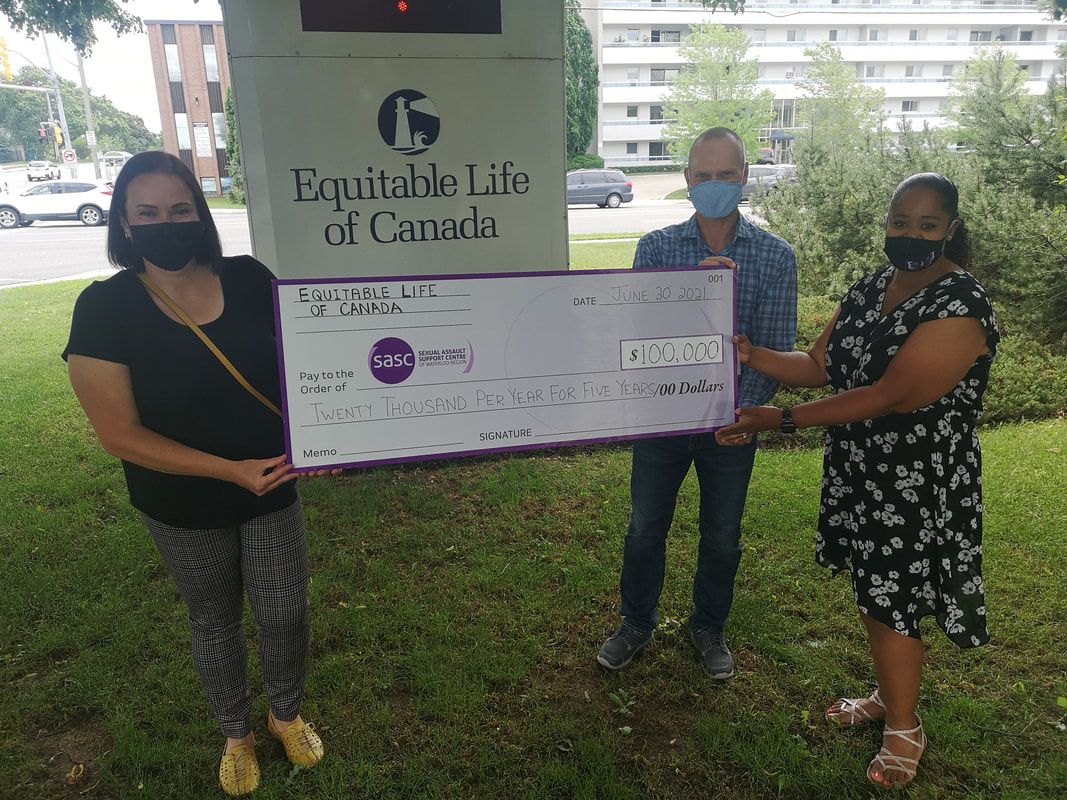 The Sexual Assault Support Centre of Waterloo Region’s Executive Director, Sara Casselman (left), is presented with a cheque from Equitable Life of Canada staff, Cam Crosbie and Donna Warner.
KITCHENER, Ont — The Sexual Assault Support Centre (SASC) is celebrating a significant funding commitment from Equitable Life of Canada (Equitable); the mutual company is giving back with a $100,000 pledge to the Centre’s Counselling Program, spread out over five years. SASC’s Executive Director, Sara Casselman, says that the funding comes at a time of urgent need. In recent years, issues like the #MeToo movement and the COVID-19 crisis have caused more and more survivors to reach out for help. "Over the past few years, demand for our Centre's services has skyrocketed, due to the impact of the #MeToo movement, and now, the added challenge of a global pandemic. At any given time, we have well over 100 people waiting to access our services. Gifts like the one from Equitable help us to live out our promise to all survivors: you are not alone.” Equitable, a well-established company in Waterloo Region (they celebrated their 100th anniversary in 2020), responded to the community’s increased need for sexual assault support services over the past few years as a sponsor of SASC’s annual fundraising gala. When COVID-19 placed restrictions on in-person events last year, Equitable continued to support the Centre’s virtual fundraising initiatives. As the pandemic continued and SASC faced another year of cancelling in-person events, Equitable committed to increased and longer-term funding, living out the mutual company’s vision of corporate social responsibility. “We are thrilled to be able to come alongside SASC and help support their mission,” said Rebecca Freiburger, Director, Corporate Communications at Equitable Life of Canada. “The work they’re doing in our community will continue to transform the lives of those affected by sexual assault and provide hope to survivors and their families.” Casselman says the gift will help create needed change for local survivors. "Equitable's investment is a wonderful commitment to supporting survivors in our community. This gift will wrap survivors in community care when they need it the most by helping our Centre to grow and sustain our Counselling program. We are so thankful for this meaningful contribution." -30- About Sexual Assault Support Centre of Waterloo Region For over 30 years, the Sexual Assault Support Centre of Waterloo Region (SASC) has wrapped survivors of sexual violence in community care. From counselling, court support, practical assistance, advocacy work and more - SASC walks beside survivors through their entire healing journey. Services are free and come without time limits. SASC’s motto to survivors is: “You are not alone.” www.sascwr.org For additional information about this release, please contact: Sara Casselman, Executive Director Phone: 519-571-0121 ext. 100 Email: [email protected] March 16, 2020
Dear Friends, For more than 30 years our Centre has wrapped survivors of sexual violence in community care. Our motto has always been you are not alone. As we navigate the COVID-19 pandemic, we’re committed to continuing to live this out. In this time of uncertainty, we realize that survivors of sexual violence need our support more than ever. With this in mind, we’re doubling our capacity to respond to survivors on our 24-Hour Support Line. You can reach us any time of the day or night at (519) 741-8633. A trained and caring member of our team will respond; our volunteers and staff will be working in collaboration to ensure support is there when you reach out. In order to ensure the well-being of survivors, our team members, and our community more broadly, our Centre is implementing the following changes, effective March 17, 2020: Our office is closed to the public until it’s safe to re-open. Our staff team will be working remotely whenever possible to ensure the continuation of our services.
The following programs will move to an online and/or teleservice (Zoom) model. Staff members from each program area will be in touch with our clients to arrange details for:
While in-person group and workshops have been suspended, we will soon be offering online workshops (via Zoom) for survivors. Necessity is the mother of invention! More information about these workshops will be posted on our website and on social media soon. We’re committed to implementing new and innovative ways to continue our long history of caring for survivors in Waterloo Region. Much like all of you, we’ll continue to monitor this situation closely; if changes are required, we’ll post updates. Please follow us on Facebook, Twitter, and Instagram (@SASCWR) or visit our website at sascwr.org for the most up to date information. I believe an attitude of gratitude can be transformational during challenging times. Today I’m grateful for the community that surrounds us. I’m grateful for our volunteers, picking up extra shifts on our 24-Hour Support Line. I’m grateful for colleagues that voluntarily forfeit vacation to help with pandemic planning. I’m grateful to be part of a team that would move heaven and earth to ensure our services continue to exist. I’m grateful for a Board of Directors, who sincerely cares about our mission and the wellness of our team. I’m grateful for our donors, who demonstrate their solidarity in such a tangible way. You are not alone…and neither are we. I wish everyone good health and well-being during this time. For local updates, and for tips on how to protect yourself from COVID-19, please visit: http://www.regionofwaterloo.ca/COVID19 Sincerely, Sara Casselman Executive Director Sexual Assault Support Centre of Waterloo Region |
AuthorWrite something about yourself. No need to be fancy, just an overview. Archives
July 2022
Categories |

Follow Us
.
SIGN UP FOR OUR "FRONTLINES" NEWSLETTER
|
MAIN OFFICECAMBRIDGE Satellite Officethe Hub @ 1145, 1145 Concession Road, Cambridge, ON N3H 4L6
Charitable Registration Number: 132274093RR0001
© 2023-2024 Sexual Assault Support Centre of Waterloo Region. All rights reserved. |

 RSS Feed


